
I previously gave a glimpse into Census Records in my blog “Filling the Gaps – Part One.” which was published on 21 April 2023.
What is a census?
The Collins dictionary states: “A census is an official survey of the population of a country that is carried out in order to find out how many people live there and to obtain details of such things as people’s ages and jobs.”
https://www.collinsdictionary.com/dictionary/english/census
Why were they taken?
A census gathers information about the general population so a snapshot can be provided to authorities to enable them to determine where or what infrastructure i.e. schools, roads and supermarkets etc. is needed within communities.
How often and when?
Usually, a census is carried out about every ten years (In Australia and UK – other countries may be different). The timing of these events does change due to various reasons. I am no expert in this field. The information provided is what I have found during my research and from various reading materials.
The following table shows the dates census records were taken in the United Kingdom:
| Year | Date | Year | Date | Year | Date |
|---|---|---|---|---|---|
| 1841 | 6 June | 1851 | 30 March | 1861 | 7 April |
| 1871 | 2 April | 1881 | 3 April | 1891 | 5 April |
| 1901 | 31 March | 1911 | 2 April | 1921 | 19 June* |
Census records were also taken in 1801, 1811, 1821 and 1831. Most of these did not list full households and many have not survived.
Examples.
The following show the differences between the census paperwork in 1841, 1881 and 1921.
You can tell the difference between these three census records by just looking at them.
1841 Census Example.
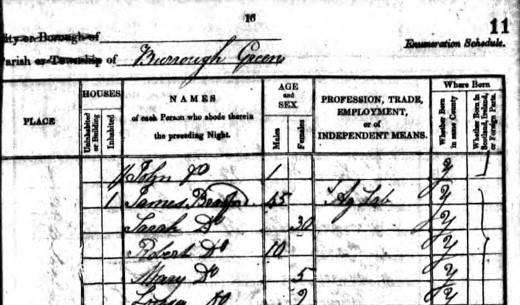
The 1841 census lists basic information – name, age, occupation and if born within the county.
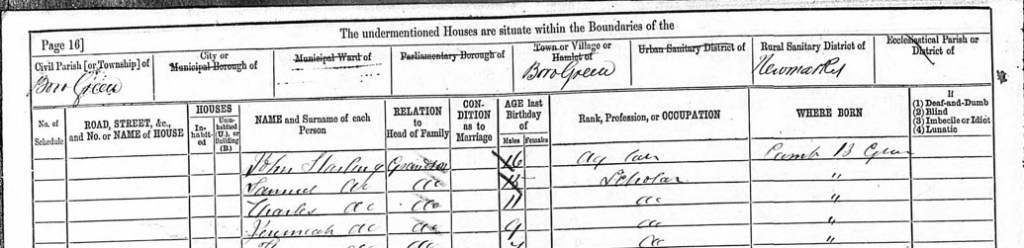
1881 Census Example.
The 1881 census is expanded mostly with where born and if the person identified as being deaf-dumb, blind, imbecile or idiot and lunatic.
1921 Census Example.

The 1921 census asks for age in years and months, asks who the employer is if the person is working, if the person was born outside the UK and asked which country they were born in. There was a divorce option available. Plus more…
Please note all the above example images have been taken from Find My Past.
Not Available.
Some records have not survived between 1841-1921. Always check where you are researching as you do not want to waste your precious time. Some reasons why these records are not available are due to water damage, lost or have been destroyed.
Surrounding Pages.
One thing that I do when looking at census records is to look at the surrounding pages (i.e. neighbours). If it is a small village – look at the entire census. You may locate relatives. This became more difficult in the 1911 and 1921 censuses as individual forms were completed.
Website.
Check out the following website for more in-depth details:
https://www.nationalarchives.gov.uk/help-with-your-research/research-guides/census-records/
Explore and Discover
= find new relatives =
 Ancestor Family