
Oban Bay.
In 1883, two of my ancestors arrived. The first was my maternal Scottish great-grandfather. He was onboard the “Oban Bay” which departed Glasgow. The second voyage in 1883 will be in the next instalment of “The Arrivals.”
Golden Find.
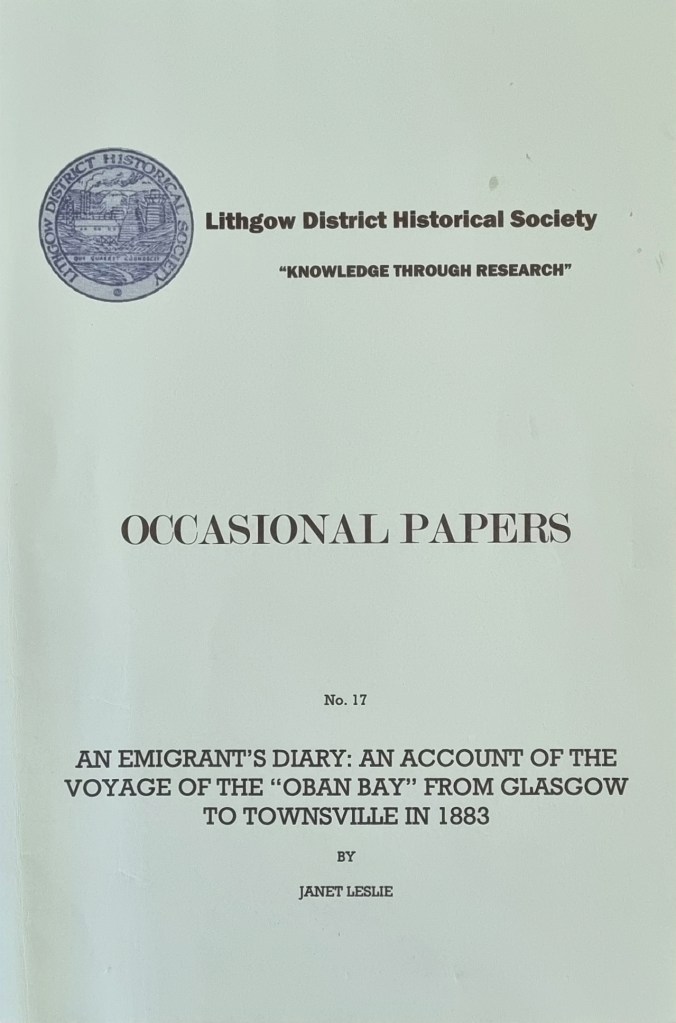
My lucky find – A diary of a fellow passenger named William Smart. The diary was transcribed by Janet Leslie in 1974. It is believed that Janet typed the book from the original handwritten diary. It is titled “An Emigrant Diary: An account of the voyage of the “Oban Bay“, from Glasgow to Townsville in 1883”. National Library of Australia ISBN 085866 014 8. William Smart is Janet Leslie’s grandfather.
No photograph of the “Oban Bay” has been located. However, within the diary, William Smart produced a drawing of the vessel. It has not been reproduced here due to copyright issues.
Shortage of Sailors.
The ship, “Oban Bay” was built in 1876 and was a 1200-ton vessel. The length from stem to stern was 200 feet. On Wednesday 28 March, the vessel was lying at the Tail of the Bank due to a lack of seaman in the Glasgow district. The men who were to become part of the crew arrived from Liverpool and went immediately to the ship in Greenock.
At the commencement of the journey, the passenger nationalities were: 52 English, 283 Scottish, 43 Irish and 4 others. Totalling 382 souls.
Voyage.
The voyage of the “Oban Bay” began on Friday 30 March as those travelling readied themselves to board the ship assembling in Glasgow to bid farewell to family and friends. In charge of the ship was Captain Peacock. Dr. Ross was the surgeon-superintendent and Miss Talbot was the matron. It is known that the vessel left port around 10am to the sounds of “Auld Lang Syne”, as the vessel headed down the Clyde out into the Irish Sea.
Seasickness.
Records located show references relating to the beginning of the voyage that many onboard had seasickness – some badly. Some of the detail is graphic.
Troubles at Sea.
Only five days into the journey, the vessel was in calm seas off the Irish coast and began drifting toward rocks but was saved by a passing tug.
Within the first couple of weeks, the freshwater condenser broke down and the ship’s engine developed troubles that needed repair. The repairs were carried out at Funchal on the Island of Madeira. “It is interesting to note that this voyage took place 140 years ago…” During the time in the location, native boats visited the ship several times attempting to sell their wares which included fresh fruit and produce as well as trinkets including large brimmed hats that would become very useful later in the voyage as they head into the tropics.
As the vessel moved southward, the temperature was on the rise. After Madeira serious bouts of diarrhoea set in. The Doctor had warned passengers not to partake in eating too much fresh fruit which seemed to be the cause of the outbreak.

Stolen.
Throughout the journey, bread and other supplies were stolen. About a month into the journey, William Smart reports, two Englishman are handcuffed and taken to the bridge where they stayed for two weeks. Fellow passengers signed a petition to have them released but it appeared to have fallen on deaf ears.
Crossed The Line.
Rain showers commenced in the tropics and on Sunday 29 April the vessel “crossed the line”. The vessel had been making a slow pace after leaving Madeira.
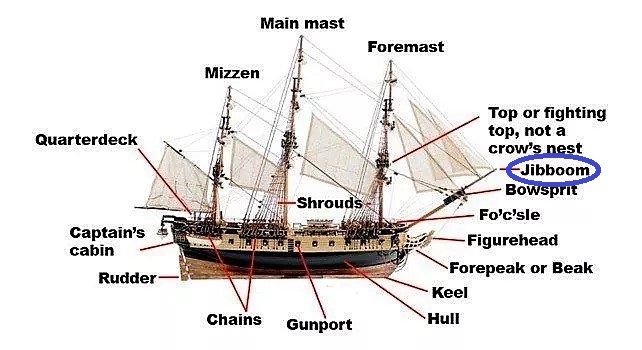
Heavy seas were encountered, as fresh winds picked up causing the jimboom (jibboom) to snap and cause an almighty racket during the small hours. The repairs took several days.
Burial at Sea.
By this time the vessel was drifting towards the South American coast. Temperatures had risen hitting the 80s, however, this would soon change. Various bird life, fish, as well as whales are reported. In the diary on Thursday 17 May, William Smart rights graphic details of a burial at sea – the deceased, John Shaw aged 28 – Shoemaker. The exact location is given where he died in longitude and latitude measure.
More Troubles at Sea.
The temperature is beginning to drop as they near the Cape.
It is believed to be the Cape of Good Hope. More bird life is mentioned over the next couple of days (Friday 18 and Saturday 19 May), before the ship picks up speed heading in an easterly direction.
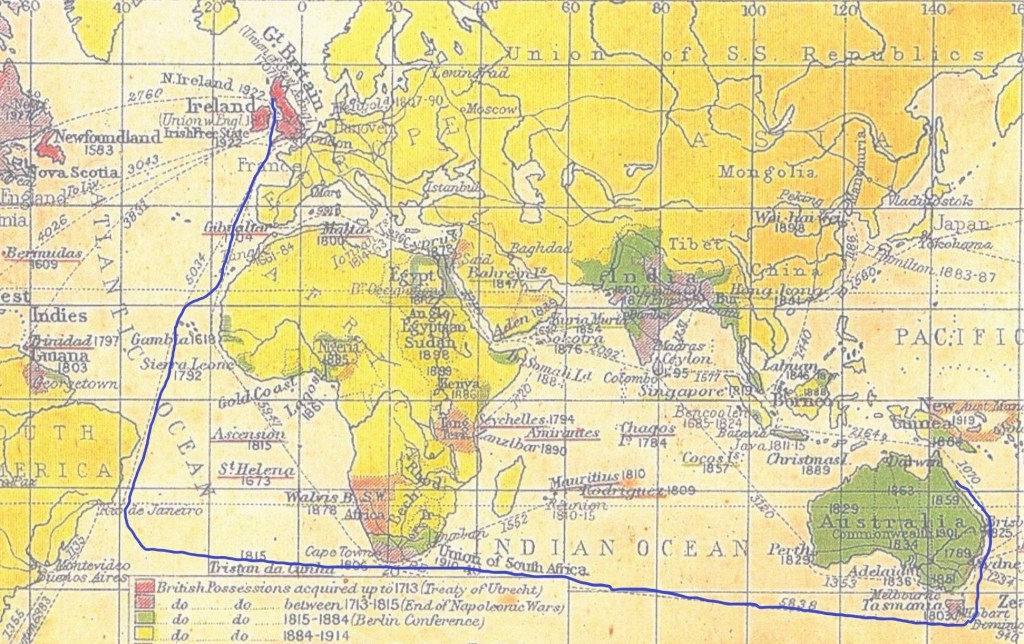
Due to the speed the ship rolls and dips making it difficult to stay in one place. Interestingly, no sickness is noted in the diary. Over the next couple of weeks, passengers have to deal with the cold of the southern oceans. The ship encounters mountainous seas during a storm which is described as a hurricane. Again, the jimboom (jibboom) snaps. Two sailors who are part of the crew, are injured around this time.
Snow.
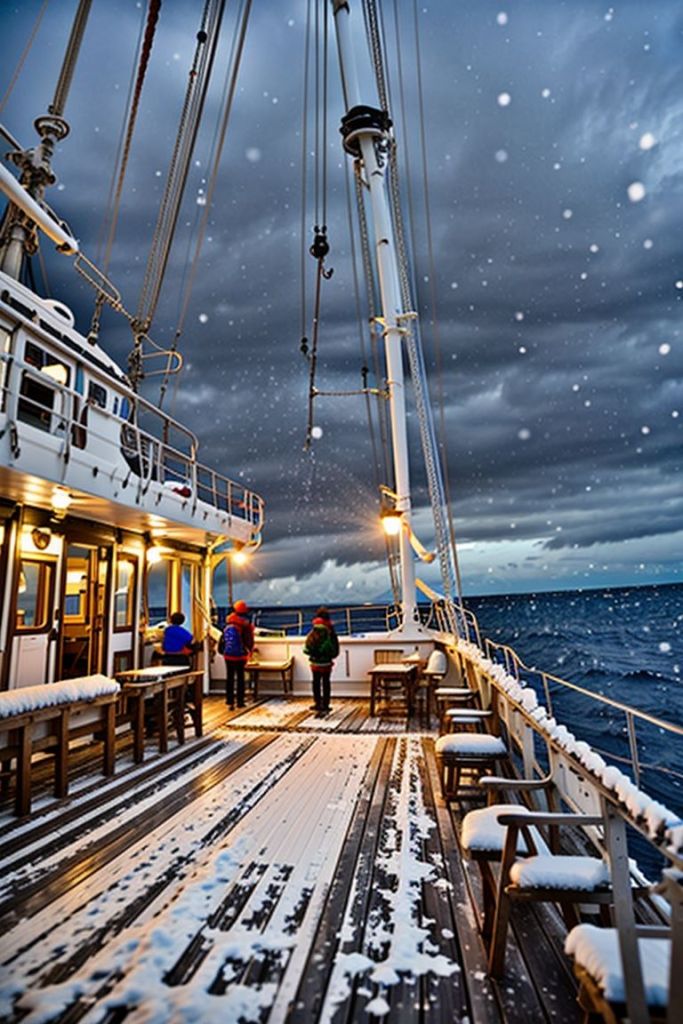
Snowfalls on the vessel on Monday 25 June as the temperature drops to the low 40s allowing passengers to have a game of snowballing.
At the end of June, the ship rounds Van Diemen’s land and begins the northward journey.
The ship travels along the eastern coastline of Australia but does not stop at any ports.
Journey End.
As the journey nears its end there is mention of lice and tick infestation, particularly in the bedding. The “Oban Bay” nearly runs aground on coral reefs before being calmed just off Townsville. Passengers had to wait on board for clearance to go ashore. On Friday 13 July, approximately 105 days after leaving Glasgow, the ship docks in Townsville. Single women are taken ashore first at 10 o’clock followed by the married couples and then the single men. All are transported to the depot. There are 379 passengers consisting of one full paying, 61 assisted and 320 free. There were three births and 6 deaths during the voyage.
= * = * = * = * = * = * = * = * = * = * = * = * =
The new adventure begins…
Explore & Discover…
= * = * = * = * = * = * = * = * = * = * = * = * =
Acknowledgements:
Golden Find Booklet: Lithgow District Historical Society (note: spelling of JIMBOOM, taken directly from diary.)
Ship parts: https://www.thefactsite.com/parts-of-ship/
Map: pixabay.com
Snow on board: Leonardo.AI
 Ancestor Family