
Hampshire.
The second arrival in 1883 was another maternal great-grandfather. He left Plymouth and arrived in Rockhampton. He was with an older brother on board the “Hampshire.”
Research Mix-up.
The research into this ship has been very different. I wrote about what I had found, but the dates of travel did not line up with the source materials found – mainly the passenger list. I ended up scrapping what I had written previously.

The reason being there were two ships named “Hampshire” that travelled to Australia at about the same time. One was a steamer and this one was a sailing ship.
New Owners.
With all that out of the way, this “Hampshire” had new owners – Capt. Joseph Hossack of Liverpool purchased the ship in June 1883. Messrs C. Bethell & Co were also part owners.

Alterations and improvements made to the ship affected the saloon and steerage accommodation to enable the ship to provide exclusive passenger work for the new business. The ship of 1164 tons was a Barque.
The ship was chartered by the Queensland government on her maiden voyage under the new owners. The vessel was under the command of Capt. John Mathias. He had a long connection with this ship for 15 years from boy to master. Several petty officers who had sailed under the previous owners spoke highly of the sailing qualities of the “Hampshire“. The previous owners were Money, Wigram & Sons.
Plymouth.
The vessel set sail from London on Saturday 28 July and headed toward Plymouth where my great-grandfather and his brother boarded the vessel. They joined 459 immigrants and 43 crew. Dr. Ledingham was a surgeon-superintendent and Mrs. Jardine was the Matron. The “Hampshire” departed on Friday 3 August. It hasn’t been determined how Henry (my great grandfather) and his brother, Thomas travelled from Ludlow, Shropshire to Plymouth. It would appear the most likely journey would have been by train. Investigations continue but are not a high priority.
Possible Journey.
Newspaper reports indicate information relating to the voyage had been extracted from the ship’s log. These reports have been used to track the possible journey. There are gaps within the reports and it is difficult to know what occurred throughout the journey or which route it took.
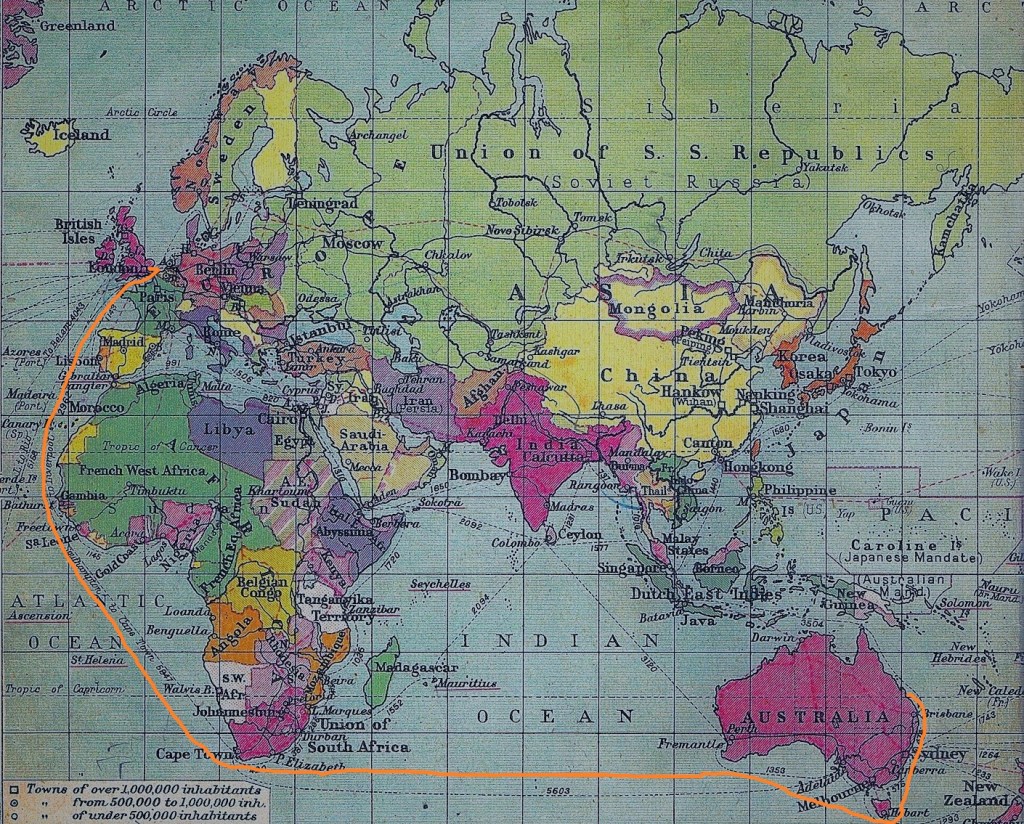
Records indicated that during the voyage, there were 6 births and 6 deaths (all being young children).
Heavy Going.
Light winds from the southwest to the northeast are encountered upon leaving the English Channel, as the vessel had made little progress in the first week. The ship continued its slow southward movement due to very light winds. Eventually, the ship picked up the southwest monsoon winds and the vessel had a good run through the northern tropics. On Thursday 30 August, the equator was crossed at longitude 13° west. There would have been a celebration at this time. The “Hampshire” travelled well offshore of the African coast, catching the southeast Trade winds. On Tuesday 18 September at latitude 37° south, the prime Meridian was crossed. 50 days out from Plymouth, the vessel rounded the Cape of Good Hope. It’s Sunday 23 September. It is noted that the weather has been exceptionally fine. The top-gallant sails had not been taken in nor had the barometer fallen below 30 inches.
Indian Ocean.
The vessel made an easterly run on the 41° south parallel in moderate winds ranging from northwest to southwest where mostly fine weather was encountered. However, the occasional gale occurred. Crossing the Indian Ocean, the “Hampshire” passed by Cape Leeuwin (Western Australia) on Sunday 14 October, 71 days had now passed since leaving Plymouth.
Tasmania.
The ship crosses the Great Australian Bight and nears Tasmania nine days later – Tuesday 23 October. A northeast gale was encountered with the barometer down to 28.8 inches. The sea is quite turbulent. Eventually, after a few hours, there was complete calmness. It is now Friday 26 October. Rounding Tasmania, the passengers encounter storms, lightning, heavy rain and waterspouts. From Tasmania, the “Hampshire” sailed northward along the eastern coast of Australia.
Rockhampton.
The vessel arrived at Seaview Hill, Keppel Bay on Tuesday 6 November at about 6am, some 93 days after leaving Plymouth.
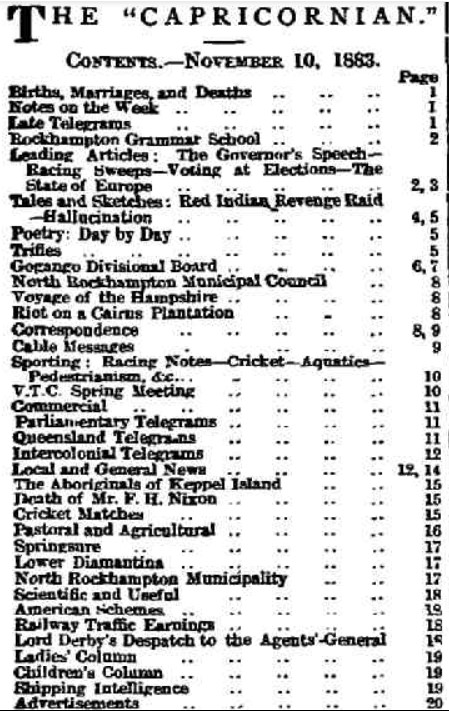
The immigrants were granted pratique by the health officer and were taken to the depot in Rockhampton on board the s.s. Taldora. General cargo was also unloaded. Those who arrived at Rockhampton consisted of 405 English, 6 Scotch and 50 Irish. These are made up of 75 married couples, 125 single men, 60 single women and children (51 males, 53 females and 22 infants).
Note: The Capricornian newspaper prints details of the voyage on 10 November 1883 edition, page 8.
Newspapers reported the following information relating to the occupations of those who arrived: 58 female domestic servants, 6 gardeners, 5 masons, 87 farm labourers, 33 general labourers, 9 miners, 1 cooper, 3 blacksmiths, 4 bricklayers, 1 engineer, 2 sawyers, 25 carpenters and joiners plus 2 plumbers.
It would have been a good start for the new colony at Rockhampton with these additional hands to make the region their new home.
Acknowledgements:
Ship photo: http://www.historic-shipping.co.uk/monwigram/hamp%2070.html
Map: pixabay.com
The Capricornian Contents: 10 Nov 1883, https://trove.nla.gov.au/newspaper/page/6855730
 Ancestor Family