
Dacca.
There was only a year to the next arrival, a maternal Scottish great-grandmother arrived. She was on board the “Dacca” which departed from London and arrived in Townsville.
Background.
Before we commence our journey, here is a little background information. My question about how did my great-grandmother get from Scotland to London to embark on her journey? Here is the answer. An article found in the “Dundee Courier” states, a Mr Randall and Mr Fleming made an extensive tour of the north of Scotland. They travelled to several towns and cities as well as the Orkney Islands. These visits were advertised mostly in railway station waiting rooms. Meeting places were provided and when those who were interested attended the meetings, they received information regarding the colony. The article states that the male applicants being described as strong and hard-working. The young women being described as healthy and well-qualified for colonial life. Many applicants were approved for free passage to Queensland.
From Scotland.

Those chosen assembled in Dundee prior to Saturday, 22 June and boarded the steamer “Dundee”. They headed south to London to join up with the “Dacca”. There were about 40 Scottish souls who joined those waiting at Gravesend, London and boarded the ship which departed on Wednesday 26 June. There were 199 single men, 227 single women, 103 married couples and children, making 529 passengers.
Journey Begins.
The vessel enters the North Sea and then makes a right-hand turn into the English Channel. By Thursday 27 June, the ship passes by St. Catherine’s Point on the Isle of Wight. The journey continues down the channel and is at Plymouth by Friday 28 June.
The next couple of days, the Captain steers the “Dacca” across the Bay of Biscay, down the Portuguese coast before heading east past Gibraltar into the Mediterranean on Monday 1 July.

Scuttled.
At latitude 36° 46 N. longitude 0° 5 E., the ship encounters a derelict vessel with no name. The Captain decides to scuttle it as it is blocking shipping lanes. It’s Tuesday 2 July.
Hot Days.
On Friday 5 July, the “Dacca” arrived at Malta.
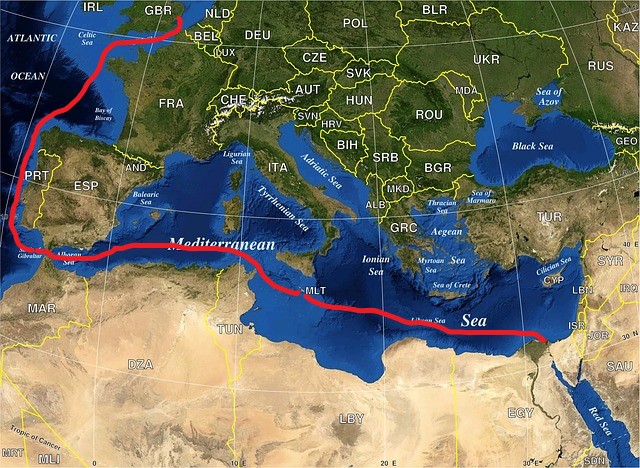
Continuing roughly east the vessel arrives at Port Said around Tuesday 9 July. It is thought the vessel took on further provisions before entering the Suez Canal and then sailing down the Red Sea.
Those on board experienced a few very hot days as they travelled south. Newspaper reports indicate the ship arrives in Aden on Sunday 14 July. The exact time is not noted. After departure from Aden on Tuesday 16 July, the ship encounters Southwest winds and cloudy weather in the Arabian Sea. The weather worsens to moderate gales causing high seas and a heavy swell. Four days later, conditions improve and the next day, Sunday 21 July, the weather is described as a gentle breeze and cloudy with a passing shower.
Entertainment.
There is a crew change at Colombo on Tuesday 23 July and a new native crew received on board. It is unknown if new provisions were taken on board or how long the vessel was in port. The voyage continued across the Indian Ocean and would have “Crossed the Line”.
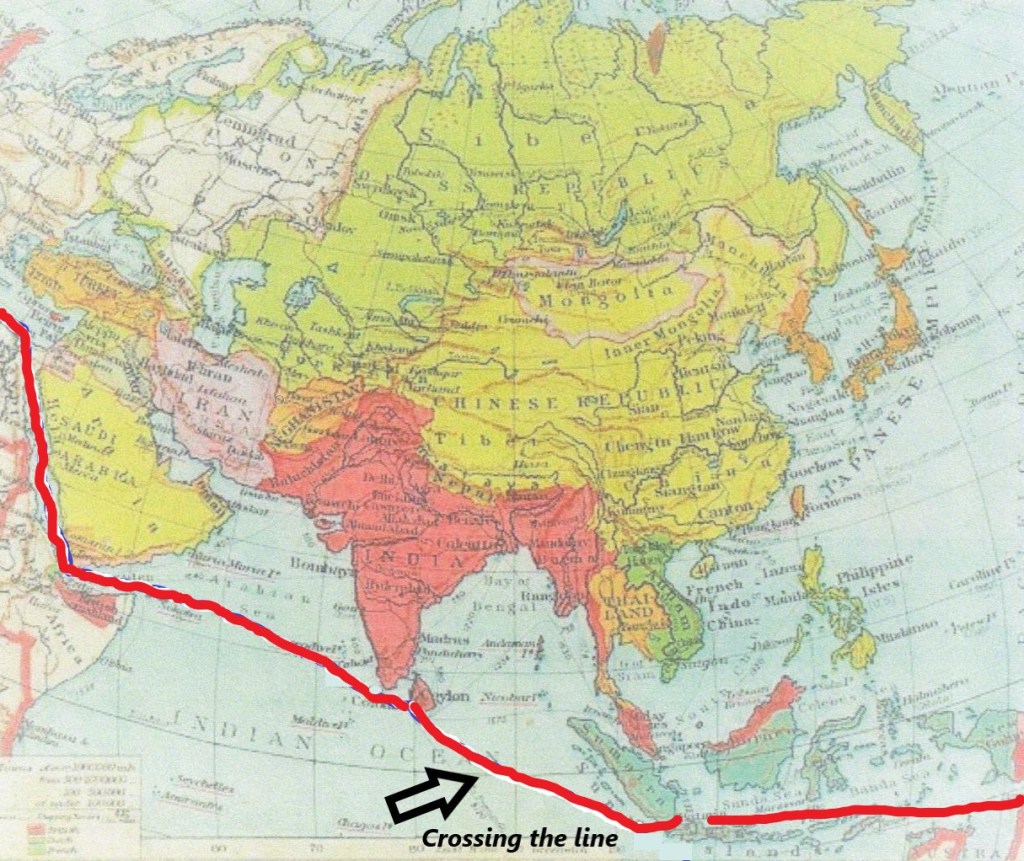
This would have most likely been a celebration time. It is known that throughout the voyage, the immigrants made their own musical entertainment and dances to pass the time. Quartermaster Woodley and Dr Hickling performed entertaining songs, gave recitations and character sketches which were well attended. Miss Mullen, the matron, was also involved.
Batavia.
It is unknown when the ship arrived at Batavia where it most likely took on further provisions. The ship departed on Wednesday 31 July. The journey taken from Batavia to Thursday Island may have been via the Java, Banda and Arafara Seas.
Early Arrival.
On the morning of Thursday 8 August, the vessel arrived four days early to the contract date at Thursday Island. Here seven passengers disembarked and 67 tons of cargo was unloaded.
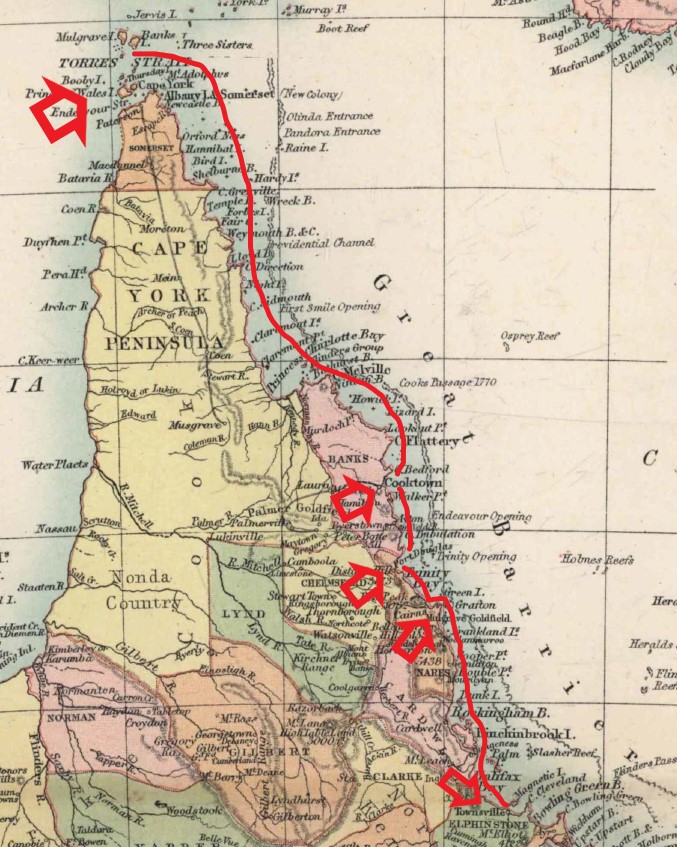
The ship sailed on Friday morning heading for Cooktown where it arrived at 6pm on Saturday 10 August. 16 passengers disembarked and 87 tons of cargo was unloaded. The ship sailed the next morning. Port Douglas was the next port of call where 10 passengers left and cargo of 40 tons was unloaded. Onward south to Cairns where only four passengers disembarked on Sunday 11 August.
An interesting article was discovered in the Cairns Post published on Wednesday, 14 August about a great demand for female servants in the town and district but immigration business transacts elsewhere in the State.
Disembarked.
The ship anchored at Townsville during the night of Monday 12 August. My great-grandmother leaves the “Dacca” after 47 days on board on Tuesday 13 August. Another 85 passengers disembarked along with the unloading of 325 tons of cargo.
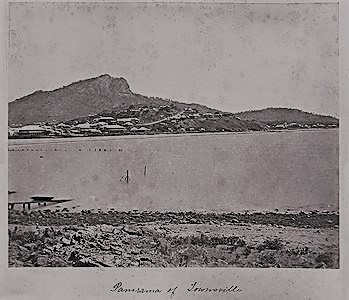
The immigration agent Mr Wallace had asked and offered 80 men employment in the Mackay area due to labourer shortages but only five volunteered.
An update to those who disembarked in Townsville was provided in the Tuesday 20 August issue of the Daily Northern Argus newspaper which stated 10 of the 30 single girls who arrived took up the engagement of the married couples and only one was still at the depot. The young single men were “going off” fairly well – eight engaged on the morning of the 13th.
Onward South.
The vessel continues its journey southward calling at:
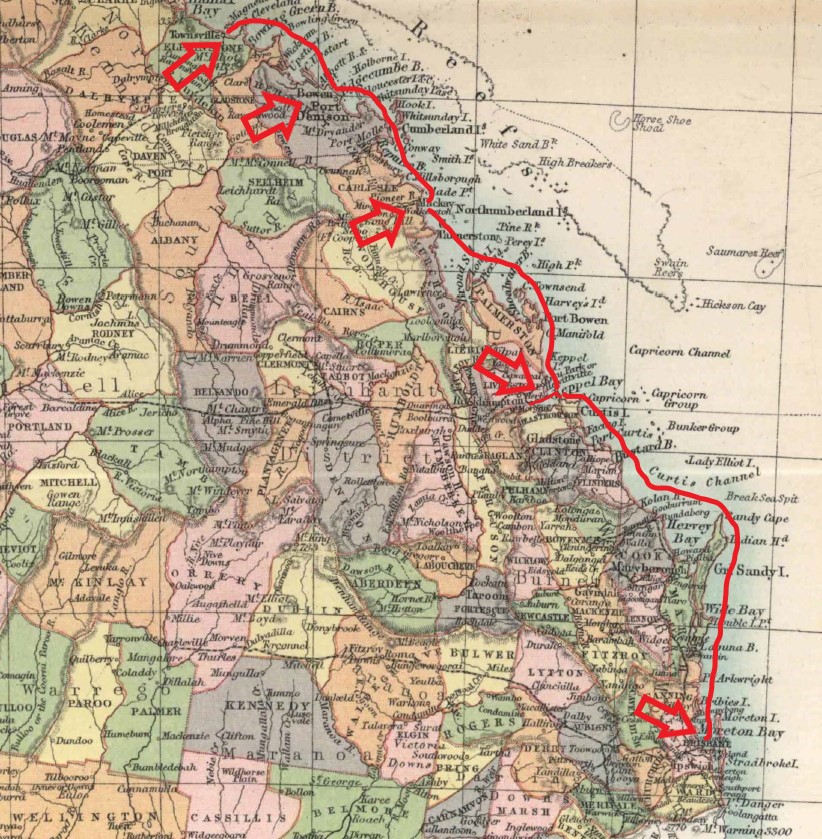
Bowen: Tuesday 13 August – 4 passengers alight along with 8 tons of cargo, Mackay: Wednesday 14 August – 44 passengers alight along with 5 tons of cargo, Rockhampton: Friday 15 August – 89 passengers alight and 94 tons of cargo is unloaded.
Final Destination.
The ship left Keppel Bay at 3pm on Saturday 16 August and arrived on Sunday 17 August at Brisbane with the final 269 passengers disembarking at Gibbs, Bright & Co’s wharf, Kangaroo Point. The last of the cargo, 3324 tons was unloaded. It appears the vessel arrived and unloaded three days early under contract.
Report.
Dr. Thomas Hickling reported during the voyage there was one birth and one death – a child who was sick upon departure from London. Discipline and order were maintained throughout the voyage. There was no sickness. The journey was pleasant and uneventful. It was noted that some first-class passengers formed a squad of naval volunteers and conducted musketry exercises with the chief engineer, Mr Stewart, as the leader.
542 souls are shown on the passenger list. The breakdown was: English 239, Scotch 126, Irish 163 and 14 others which comprised 6 Prussian, 6 German, 1 Swed and 1 unknown nationality).
A note at the bottom of the passenger list states: 2 single men who worked their passage out included in the Free landed at Brisbane in the General Summary.
Acknowledgement:
Maps: Pixabay.com; 1890 Australian Handbook – Queensland Section, ISBN: 978 1 925135 52 7, www.archivedigitalbooks.com.au
Ship photo: https://findboatpics.com.au/spbi.html
Old Townsville: http://bonzle.com/c/a?a=pic&fn=x0a8a6ma&s=3
 Ancestor Family