
Waipara.
Even though this is the last in the series – “The Arrivals”, it is not the end. Twenty-three years have passed since the last arrival back in 1889. The journeys are only just beginning – explore and discover.
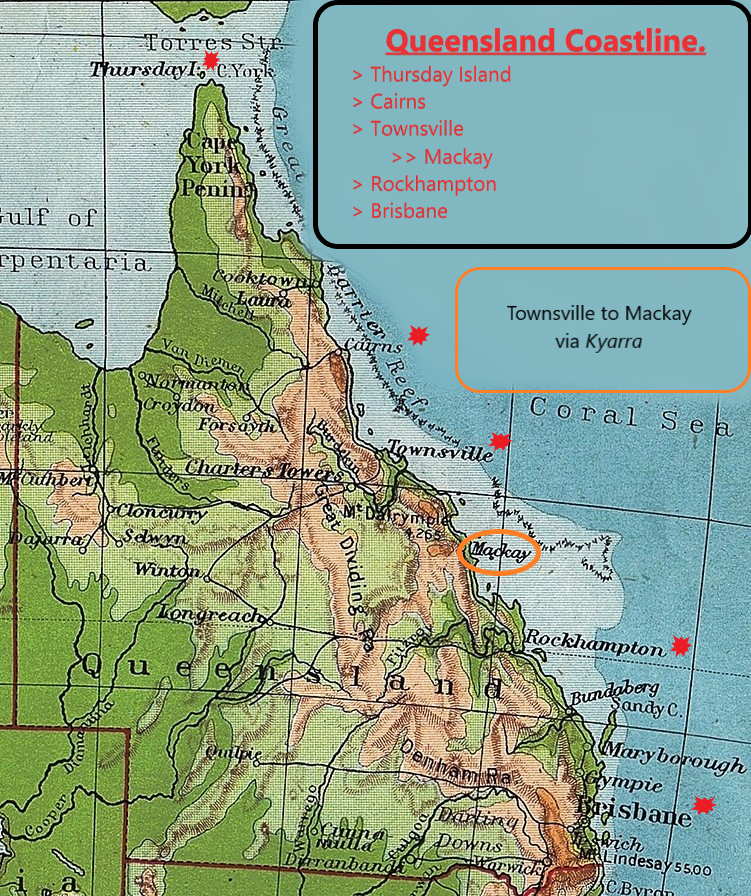
The last of my ancestors to arrive were my parental great-grandparents and my grandfather. The family set sail on board the “Waipara” from London and arrived at Mackay via Townsville.
Two Attempts.
My paternal line had two attempts to leave England. They were listed on another ship that sailed earlier but all their names had a line through them. It is unknown why there was “a change of mind”. If extensive research wasn’t done, the incorrect details of their arrival may have appeared. My great-grandparents would have had a lot of organizing to do, as besides themselves they had their children with them, which included my grandfather who was one year old. I am fairly sure they would have been some sadness in leaving what they knew and travelling to an unknown distant land. My great-grandmother had a brother already living in the Mackay region so it is possible they knew what to expect.
Departure.
The “Waipara” was at shed 28, at the Royal Albert docks prior to taking on passengers at Gravesend. There were 368 passengers made up of 350 nominated and 18 full payers. The nationalities were: English 232, Welsh 4, Scottish 71, Irish 52 and 1 from a British Possession, 7 Danes and 1 Finn.
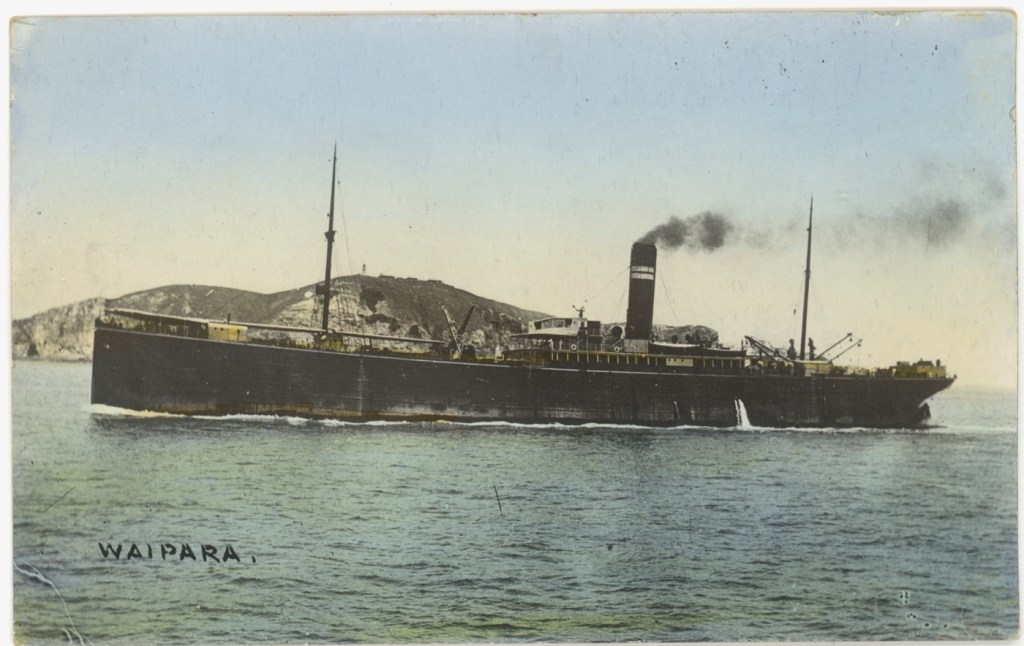
The ship set sail from London on Saturday 26 October, heading out to the North Sea and then turning right into the English Channel. It appears the steamer had a good run and was off Lizard Point, Cornwall by Tuesday 29 October.
The vessel turns south and encounters unfavourable weather conditions when crossing the Bay of Biscay. The ship would have sailed down the Portugal coast before passing into the Gibraltar Straits and into the Mediterranean Sea. It headed toward Port Said arriving on Saturday 9 November. It is thought the ship took on provisions and departed on Sunday 10 November. The ship entered the Suez Canal and then into the Red Sea passing Perim on Friday 15 November. It is unknown if the ship stopped at Aden like most other vessels.
Cyclone.
When crossing the Arabian Sea, the ship needed to avoid a cyclone so as to minimize any discomfort for the passengers. Newspaper reports indicate the ship diverted 300 miles for this to occur.
Colombo.
The day before arrival in Colombo, a Mr. Caulfield died from enteric fever (typhoid) and was buried at sea. He left behind a widow and four young children who continued on their journey. Dr Campbell, the ship’s medical officer, advised that no other cases had occurred but precautions were taken. It is suggested that the man must have been infected before joining the vessel. The ship docked at Colombo on Sunday 24 November and departed the next day. It may have taken on further provisions but no evidence was located.

The vessel would have sailed into the Indian Ocean toward Australia. “Crossing the line” would have also occurred but no mention of this was found during my research. Most ships travelling this path headed toward Batavia, again no evidence was found. There is no mention of Batavia shown on the passenger list.
Newspaper reports showed that the ship docked at Thursday Island on Tuesday 10 December just two weeks after leaving Colombo.
East Coast.
The journey south down the East Coast of Australia continued. There is some confusion about the dates mentioned in newspapers when the vessel was arriving at the different ports. From what has been determined the ship arrived in Cairns on Thursday 12 December and was lying at anchor offshore. The “Waipara” draught was 25 feet and was not able to berth at the wharf. The ship departed on the evening of Friday 13 December.
By this time my great-grandparents and their family would have been preparing themselves to disembark at Townsville. The “Waipara” arrived there on Saturday 14 December. The cargo that was unloaded here was largely Christmas goods. However, a steam tractor engine was also unloaded for Mr. Deane of Haughton River. The engine weighed about 13 tons.
Those who disembarked in Townsville were treated to a welcome tea on Monday afternoon which was provided by YWCA with Mrs. Colville presiding.
Mackay.
It is unknown how long my great-grandparents spent in Townsville as they transferred to another vessel – “Kyarra”. The “Kyarra” left Townsville for southern ports on Monday 16 December. It appears this vessel arrived in Mackay on the evening of Tuesday 17 December. Their total journey from London to Mackay spanned 52 days.
Continued South.
Meanwhile, the “Waipara” continued its journey southward towards Brisbane. On Wednesday 18 December, the ship was off Cape Bowling Green and heading to Rockhampton. It docked at Port Alma where passengers disembarked and travelled by train into the city. (Including the wife and four children of Mr. Caulfield who was buried at sea prior to arrival in Colombo) The cargo was also unloaded and trained into Rockhampton. During research, there were a number of articles located where there appeared to be some issues between the shipping company and the government. This is not covered in my writings.

The ship anchored off White Cliffs on Monday 23 December, past Woody Island on Tuesday 24 December. A child was born on Christmas Eve. The ship made its final destination, Brisbane, on Christmas Day. Passengers’ heavy luggage was not unloaded. However, 277 passengers disembarked.
Conversations with passengers voiced they were satisfied with their treatment on board. The trip was good except for the weather, as described earlier. Weather down the East Coast of Australia had been good and there were no other issues encountered. To pass the time sports and concerts were arranged amongst the passengers which whiled away the time very pleasantly. It was also pointed out that the accommodation and food were very good. There was plenty of food although at times was poorly cooked. It was noted that the single men’s quarters were cramped. There were no complaints made.
Stealing.
However, a couple of days after arrival in Brisbane, a number of detectives were seen at the South Brisbane wharf. It appeared that pilfering of luggage had occurred and two arrests were made.

Further details regarding this can be found via the following link:
https://trove.nla.gov.au/newspaper/article/175897636
Court Outcome.
A fireman on the “Waipara”, George Turner, appeared in court for the stealing offence. He later appeared at the District Court. He was found guilty and sentenced to one-year imprisonment with hard labour.
Acknowledgement:
Maps: Pixabay.com
Ship photo: unknown
Luggage Photo: Pixabay.com (nemo2014)
Christmastime: Pixabay.com
 Ancestor Family